Wednesday, July 29, 2020

SiriusDecisions Demand Waterfall Models

I'm sure everyone reading this has looked at something in their home and said, "This could be better organized". It might be your closet. It might be your kitchen. Regardless, a systematic approach brings order to chaos. This is where SiriusDecisions Demand Waterfall models come into play. The Demand Waterfall was designed in modules that define milestones in the demand generation and management process. The stages are bundled together in a way that aligns them with common go-to-market strategies.

SiriusDecisions published an e-book entitled, "The Intelligent Growth Playbook: The SiriusDecisions Demand Waterfall® Family" that reviews the evolution of the Demand Waterfall. In this article, I'll break down the three versions for you at a high level. My next articles will go in-depth for each version.

Version 1: The Original Waterfall

This version applies to companies that are in the infancy of their demand generation development. It's a simple process that breaks the complex demand journey into five defined stages:
  1. Inquiries
  2. Marketing Qualified Leads (MQLs)
  3. Sales Accepted Leads (SALs)
  4. Sales Qualified Leads (SQLs)
  5. Closed/Won Business
This version demonstrates a predictable flow and incorporates current conversion rates to show their effect on revenue. It also provides a common language for sales and marketing to align on and discuss strategy and outcomes.

Version 2: The Rearchitected Demand Waterfall

This version was updated in 2012. It has been enhanced to incorporate demand created by both marketing and sales. It also highlights the important roles teleprospecting and inbound marketing play in demand creation. This allows for greater granularity in the MQL stage of the process and addresses lead scoring for the automation qualified lead stage. As mentioned, teleprospecting plays a role in this more complex demand waterfall. Additional stages have also been added to provide additional insight for organizations that use internal and/or external teleservices to source and qualify leads.

Version 3: The Demand Unit Waterfall™

This version brings a new lens to the demand generation and managemet process. This last version is the most current. The methodology contained within takes the more complex technologies and buying processes into account. It also begins earlier in the demand generation journey, before direct contact has been made with the buyer, via the target demand and active demand stages. It has been updated to accommodate the rise in go-to-market strategies based on buyer needs, predictive analytics and intent monitoring, as well as the increased emphasis on account-based marketing.

As I mentioned at the beginning of this article, look for additional in-depth information on each of these three models in upcoming posts.

Tuesday, July 21, 2020

5 Strategies to Help You Master the Nonlinear Buyer's Journey

Ah, the bygone days when a customer saw an ad, went to your store, and purchased your product. In today's world, you might have searched for a product online or saw an influencer hawking it. It interested you enough to look into it and the next thing you know, Facebook is showing you ads for the selfsame product. Is Facebook reading your mind? Nope. It's just reading your data.

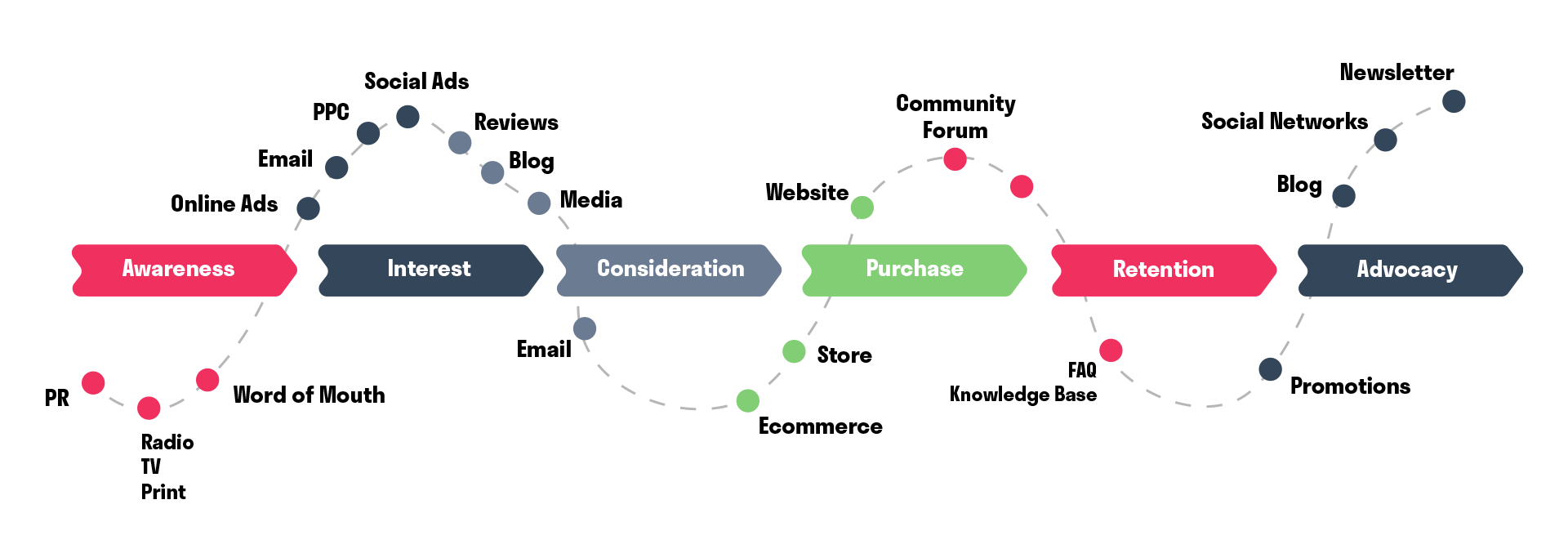
The marketing funnel is still relatively unchanged: awareness, interest, consideration, intent, evaluation, and purchase. The customer journey that is taken along that funnel is a mess. To make things even more challenging, the customer journey goes beyond social media, making its way onto televisions, radios, streaming and more. 60% of buyers don't want to speak with a sales rep and 50% have made their decision before they reach out to the sales rep. The customer journey to purchase now looks more like this:


Attribution is Key

So, how do you go about measuring the effectiveness of content and collateral that played a part in a sale? You tag it. Ok...it's not that simple. There are multiple tools out there for tagging such as Google Tag Manager, LinkedIn Insight Tag, Facebook Pixel, cookies, or any number of platforms. The point is, you need to track the behavior of your target audience in order to analyze the data around what content had what impact in their decision. Without that info, you'll be building your campaigns and content in the dark.  

Marketing Automation

One way to identify a user's messy click journey is through a marketing automation platform. There are dozens out there: Salesforce, Eloqua, Marketo, Hubspot, Pardot. Take your pick. Only you will know which one is best for your business. With the right journey orchestration platform in place, you can unlock customer intent, understand the journey, and provide the right information at the right time. Personalization is key. Many buyers don't see the difference between vendors because they are receiving generic marketing content that isn't specifically geared to them.   

5 Strategies to Help You Succeed

The overarching sentiment from buyers is that the journey needs to be personalized and streamlined. In other words, make the buyer's journey more relevant and more efficient.
  1. Create content for goals and roles
    • Learn who's involved in your customers' buyer groups
    • Understand what each type of buyer wants at each stage of the journey
    • Create a multi-dimensional content plan that maps content to the personas
    • Audit your current content for accuracy
    • Track the content type performance
  2. Deliver the right content to the right people at the right time
    • Serve up content based on demographics
    • Let AI learn and display the highest performing content for different personas
    • Build campaigns based on content types being downloaded
    • Test and optimize the content marketing strategy
  3. Personalize your marketing programs
    • Design integrated marketing programs with behavior-based triggers
    • Integrate marketing data with intelligent content
    • Customize the journey for different users
  4. Nurture leads with automation
    • Treat interactions as conversations
    • Shift the conversation based on behavioral cues
    • Respond dynamically to customer's changing behaviors
    • Collaborate with sales to ensure seamless customer experience
  5. Create a self-service online experience.
    • Connect your digital properties
    • Create easily digestible content
    • Make sure buyers can find what they need when they need it
    • Create a guided or interactive experience

Sunday, July 5, 2020

Experiential Marketing: Upgrading to the 4Es

Like many of you, I was "raised" on the 4Ps of marketing: product, price, place and promotion. It's a concept that has been around since Neil Borden introduced it in the 1950s - and it worked very well until the rise of the digital age when the consumer changed.

Today's consumer is more savvy. They are getting their information from more locations. They have shorter attention spans and want interactive experiences. They want to feel special and that the messaging has been tailored to them. They are talking to one another all the time - sharing their thoughts and experiences with products and companies. The 4 Ps were developed during a different era and they aren't keeping up with this evolution. They put the control in the hands of the companies and their marketers when consumers have moved beyond that. They have seized control and changed the game.

Marketing Needs to Evolve.

Several years ago, Brian Fetherstonhaugh of Ogilvy & Mather proposed replacing the 4Ps with the 4Es, and yet marketers continue to cling to the 4Ps. Why? Because they are simple and no one likes change - and that's been ok, until now. Now marketers are in a place where there is even more competition for digital real estate and digital audience attention. If we don't change now, we'll be left behind with DVDs, Zunes, and other relics that didn't quite make the evolutionary grade.

What Are the 4 Es?

The 4Es still maintain the basic framework as defined by the 4 Ps, but take into consideration today's environment. We live in an magical and turbulent time where there are dozens, if not hundreds or thousands, of marketing channels, content is free, and distrust of corporations and other powerful entities is on the rise. The 4 Es comprise:
  • Experience
    Experience replaces product. How? Yes, we still need to sell the product, but first and foremost we need to understand the customer journey. How do they get from first contact to customer to brand advocate? If you consider the retail experience, they succeed not so much by what they sell as by how they sell it.
  • Everyplace
    Place becomes Everyplace. It used to represent only the place where the product or service was distributed. The problem is that this places the power in the hands of the company - which is no longer true. The power is in the hands of the consumer and the "everyplace" concept forces marketers to undertake omnichannel marketing to get their products or services in front of the consumers in the places and on the platforms where they spend most of their time. Not only that, but we must get the offering in the right place, at the right time, in the right channel.
  • Exchange
    Price evolves into Exchange. In today's world, the customer's time is worth as much, if not more, than their dollar and marketers need to understand and respect that. Today, it's not just about price in trade for goods; it is the entire value experience the consumer goes through. A great example of this is the freemium model SaaS companies have adopted. They get the customer interested through a free limited version with the hope of upgrading them to a full paid version.
  • Evangelism
    Finally, Promotion turns into Evangelism. We all know the customer journey doesn't end when the dollar is handed over. Customers share their experiences with those they know and suddenly, with the advent of social, word-of-mouth is exponentially more powerful. WOM drives 13% of sales, 2/3 of which is offline. We need to find the passion and emotion in the brand and share that. Authenticity is king and this is what makes user-generated content so valuable. Apple has this "E" nailed.

Out With the Old. In With the New.

It's time for marketers to step away from the 4P marketing model and evolve to the 4E approach. Consumers want an experience and a relationship with their business partners. They want value in exchange for their time. In the end, like all of us, they want to be respected and spoken with - not pushed at and felt taken advantage of.


Wednesday, December 18, 2019

Account Based Marketing and Inbound Marketing: How They Work Together

For years, I've been advocating targeting a smaller, more highly qualified audience vs the "let's see what sticks" approach. I call it the sniper vs shotgun approach. What can I say? I'm a redneck from way back. Anyway, over the past few years Account Based Marketing (ABM) has been making its way to the head of the class and I'm thrilled beyond belief. I'm not saying traditional marketing no longer has it's place, but it's nice to see the advent of this particular philosophy.
So what is Account Based Marketing? It is, as you may have guessed, a strategy wherein valuable or desired accounts are selected and targeted rather than a more general audience. Content is then designed specifically for that account and delivered in hopes of building a relationship. It's pretty much the opposite of more traditional inbound marketing.

Inbound marketing, in the most general terms, is creating an audience, putting content out that's a fit to that audience, and then pursuing the leads acquired from that effort.


Working Together

Now, all that said...ABM is probably the more efficient marketing model as it aims for zero waste, but if you consider the two models, ABM can pick up right were inbound leaves off. With inbound, you've got this pool of leads that you want to follow up on, but in that pool, perhaps there are one or more accounts that fall within your ABM strategy. They're all warmed up and ready for you to send them the appropriate ABM-based content.

The Benefits of Account Based Marketing

Sales and Marketing Alignment

There are multiple benefits to implementing an ABM strategy. The first is better alignment between sales and marketing. We all know this is a common issue. If you look at ABM, it puts both marketing and sales focusing on the valuable accounts. In a more traditional strategy, the sales teams will be focused on the accounts while marketing will be focused on verticals and buyer personas.

Zero Waste Marketing

Account Based Marketing aspires to be highly efficient and optimized. Because ABM is so targeted you don't wind up wasting your time on chaff. All your time and efforts are focused on the customers most likely to buy.

Better Customer Experience

Your targets are now receiving content that has been personalize for them. They're not being hit with content that's targeted to a general industry or audience profile. Suddenly they are looking forward to receiving your content instead of rolling their eyes and hitting delete.

ROI

A 2014 ITSMA survey showed that companies focusing on an ABM marketing strategy consistently reported a higher ROI than what was achieved using more traditional marketing methods. This bodes the question of "Why aren't more companies investing in Account Based Marketing?"

Things to Think About

So...what are you going to do about ABM in your company? Have you implemented it and how is it comparing to traditional marketing methods? Share your thoughts!

Tuesday, February 3, 2015

Closing the Loop With Mobile

Online to offline (O2O) shopping is ten times greater than e-commerce. Did you catch that? 10X greater than e-commerce. Surveys done by Opus Research, Forrester, Yahoo and others indicate between 60% to more than 90% of internet-enabled consumers conduct online research before buying offline. As many as 80% of consumers use smartphones in-store to do research prior to buying the product they are looking at.

Mobile devices open a powerful new marketing channel that offers a way to measure the effectiveness of other media. They can be used to measure the in-store impact of advertising as well as identifying audience segments by tracking offline movements. According to Google, 32% of consumers say location-based search ads led them to visit a store or make a purchase. A Google AdWords Blog, Measure More: improving Estimated Total Conversions with store visit insights, shares two cases, PetSmart and Office Depot, that successfully employed customization to increase their in-store purchases. In January, Google rolled out an enhancement to their Estimated Total Conversions metric that allows for a store visit measurement. This new path to purchase should have you rethinking your metrics and customer experience.

There are two keys to a good experience: customization and consistency. According to a Google-purchased study by Ipsos MediaCT, Understanding Consumer’s Local Search Behavior, 70% of mobile customers want location information for the nearest store in their ads. 74% want to know the inventory for a product at a nearby store. The other key is consistency. Marketers need to ensure a cohesive brand identity from receipt of the mobile message to action and purchase. Consumers do not like to feel confused through the process. They want to see the same product images and attributes throughout their entire experience. So how do we, as marketers, leverage the mobile marketing channel? One option is to implement a promotion code tracking system, or add the mobile channel to your already existing system. Another effective way is for marketers to send a mobile message with a unique, trackable URL. You can then track the unique URL through the purchase stream. Finally, don’t forget your CRM data. Like any other channel, marketers should be able to segment their mobile channel to better customize their messaging. Once you’ve got the tracking in place, you start dealing with the data coming back to you. Metrics are magic, but remember in this scenario there will be a lot of data so just remember to take it one piece at a time and not be overwhelmed. Analyze what is clicked, opened, or otherwise acted upon and how long it took for the recipient to act on the message. Refine your messaging. Undertake A/B testing. Retarget those that didn’t open/click with the new, more effective message or those contacts that came in from a different channel, such as a promotion with an online registration, or an e-mail opt-in.


Thanks to Rimma Kats of Mobile Marketer for the source article, “Closing the impression-to-redemption loop”.


Wednesday, January 14, 2015

4 Keys to Instagram Marketing

I have to admit, I was a little late in recognizing Instagram as an effective marketing tool. I kept hearing about it from the 20 and 30-somethings in my circles, but as far as I could tell it was nothing more than a picture sharing space. How wrong I was. Instagram is growing by leaps and bounds and if you haven’t included it in your digital marketing mix, you should probably think about doing so - especially if your target audience is anywhere in the 18-44 age range. Why? Just look at these numbers:

69% of Gen X and millennial users fall in that age range and, while the current user base is primarily female, eMarketer expects that to change to an almost even split by 2016. A March 2014 eMarketer report estimates that 40.5 million users were U.S.-based consumers logging in to Instagram at least once per month. Regular usage levels nearly match Twitter’s, particularly on smartphones.

The Instagram platform directs your user’s attention to a single photo stream, too, so it’s not as overwhelming. They are something of a captive audience, viewing one visual treat at a time.

Keys to Leveraging Instagram

  1. Add a link to your profile. This link is easy to change and should direct the viewer to whatever landing page is hot at the time. You can leverage it for your new product introduction landing page or that contest you’re currently running. At the very least, it should default to your website homepage. Social Media Examiner recommends getting a Bitly or goo.gl link for metrics purposes. This will allow you to track clicks from Instagram. If you use a regular link, Google Analytics will report the visit as direct.
  2. Keep it real. Instagram users don’t want to see obviously contrived pictures. They want to see genuine photos taken of real activities. Instagram is the ideal place to leverage user-generated content (UGC), but make sure you give the original user credit. Look for products or services in use. People want to see how those boots look with the skinny jeans tucked in. This is a great way to start a conversation.
  3. Treat it like a banner ad. Throw some text on the image. Call out whatever is important, but remember to keep it simple and to the point. This isn’t the place to call out every detail. Pithy is key here. If you have more information or a call to action, you can place it in the image caption – but you still want to keep it short and sweet.
  4. Don't spam the feed. Think of it like twitter – you don’t want to overload your followers’ feeds. Space out your posts to take advantage of the most interactive part of the day. For instance, photos garner strong interactions all the time, but apparently people won’t watch videos at work, so the best time to post videos, according to a July 2014 report by TrackMaven, is during the off hours, between 9pm – 8am EST. Day-to-day activity doesn’t vary much, but there is a slight uptick in activity on Sunday. There are also several applications that will allow you to schedule Instagram posts to take advantage of the most interactive part of the day. A couple of the most popular are:
    • Latergramme – You can upload individual images and organize when you want your posts to happen, but it won’t post for you. Starts at $9.50/month.
    • ScheduGram – Allows you to manage multiple accounts and upload and edit single or multiple images, and upload videos. Pricing starts at $20/month.

The Bottom Line

Instagram is expected to be a key player in the 2015 advertising ring. It’s growing steadily and is experimenting with advertising options. Take advantage of it now, while reach and engagement are at optimum.


Tuesday, December 9, 2014

NPS and Marketing

Too many people look at the Net Promoter Score (NPS) and think that it’s a metric that’s only useful to the customer service organization when, really, it’s a very useful tool for marketing as well. It goes a long way toward telling you if your customers are happy and loyal.

What is NPS?

NPS can be measured using three different surveys. The Relationship Survey measures the overall sentiment of your customer and reflects their feeling toward the organization based on their entire relationship with it. The relationship score is determined by asking “How likely are you to recommend the organization to a friend or family member, on a scale of 0 - 10?” The Transactional Survey measures specific “moments of truth” in their relationship with your organization. It’s sent after an interaction with the organization and is usually in the format of “How was a specific experience on a scale of 0-10?”
The Internal Survey is designed to understand what kinds of interactions your internal customers are having with your department. This might involve an analytics team sending a survey to the customer they are creating the analysis for.
I find it’s also very beneficial to add a qualitative question such as “What’s the reason behind your score”? You could find that you have an entire customer segment you are pursuing that may not be a good fit. You may get suggestions for how to improve a product. The possibilities are endless.
The results of the survey will break customers down into the following three categories:

  • Promoters (9-10): Loyal enthusiasts who will stay with the organization and refer others, fueling growth.
  • Passives (7-8): Satisfied but unenthusiastic. They’ll neither promote nor detract and are vulnerable to switching organizations.
  • Detractors (0-6): Unhappy customers who can damage the brand and impede growth.

Closing the Loop

This data doesn’t do anyone any good if you don’t turn it into actionable improvements. Depending on which journal you read, customer feedback is ignored 50%-75% of the time so use this opportunity develop an action plan determined by how the customer responded to the NPS Survey. Start developing lists based on the where someone falls in the NPS Survey or, if you’re managing the digital marketing program, you might develop a trigger based on a survey answer.
  • Promoters may see loyalty program offers arrive in their e-mail or via SMS. They could be invited to interact in your social media efforts.
  • The Passives are eligible for a number of efforts designed to move them from Passive to Promoter.
  • A Detractor’s response might trigger a landing page or an open-ended questionnaire asking how the organization failed them and how it can be corrected.
The NPS can help you better understand your company’s reputation and refine your customer segment. You have the potential to improve customer experience and the bottom line. The marketing uses to which you can put this data are varied and impactful, but only if you actually use it and keep the momentum going.


Wednesday, November 12, 2014

Influencer Marketing - Leveraging a New Target

The voice of the customer has always been critical to developing the marketing message and influencing the purchaser decision and word-of-mouth has always been the most trusted source for product and service referrals.
If you want a new doctor, who do you ask? Family members, neighbors, co-workers. You may go online and do some research, but usually you'll ask a peer for a referral or opinion as well. The same is true of a new TV, computer, dog food, or any other product or service. An interesting, and important, development to note in this new age, though, is that suddenly an opinion from a single person is going out to hundreds or thousands of individuals in their social network. According to a McKinsey Study, word-of-mouth generates twice the sales of paid advertising and has a 37% higher retention rate. The resulting amplification of peer recommendations cries out for a new marketing tactic. This is where Influencer Marketing comes in.

What Is Influencer Marketing?

Influencer Marketing is when the focus of marketing is turned from a target market to key individuals within that market. They may be buyers themselves or they may be third parties, such as vendors or subject matter experts. It basically depends on the individual's reputation, expertise or popularity. This used to mean a focus on bloggers, celebrities, etc., but in recent years the everyday joe may have just as much influence. Forbes provides this equation for determining influence:

Influence = Audience Reach (# of followers) x Brand Affinity (expertise and credibility) x Strength of Relationship with Followers

This form of marketing may mean entering into a relationship with the influencer. You might provide them with advance prototypes of a product or invite them to the corporate offices. Unfortunately, there are also drawbacks to this type of marketing. You don't have as much control and if the influencer runs afoul of the law or drops out of the grid, it will be time for some damage control.

What You Should Be Doing

  1. Interact with your customers.

    You really need to leverage your customers. Provide a superior customer experience through loyalty programs, customer advisory boards, or extraordinary promotions.

  2. Identify the Influencers

    There are a lot of tools available to help analyze the social media landscape to determine and rank the influencers. SocMetrics and Traackr are just two tools available to help you identify influencers based on demographic data. Additional options are listed on TopRank Blog.

  3. Form a Relationship with the Influencers

    Start off with a simple hello. Take steps to familiarize them with your product or service and company. A little kindness and generosity goes a long way.

  4. Provide Accessible Content

    Influencers are more likely to provide content that's easy for them integrate into their social media portals. Again, there are a number of tools, such as Zuberance and SocialChorus, to assist you in your brand advocacy efforts.

  5. Don't Forget the Little Sites

    Keep track of the trends of social media sites. You never know when the one you've been ignoring, like Pinterest or Instagram, may be the next big site.

Influencers are the wave of the future and it's our job as marketing professionals to take advantage of every possible resource and be aware of marketing trends. As Scott Cook, the founder and CEO of Intuit said, “A brand is no longer what we tell the consumer it is–it is what consumers tell each other it is.”

Monday, August 4, 2014

5 Tips for Improving Your Sales Forecasts

For many, sales forecasts are the bane of their existence. They can be inaccurate, hard to understand, and require constant supervision – something like a teenager. In many cases, they’ve been manipulated to reflect the desires of the creator or recipient, rather than being left to reflect the pure data. I’m going to provide you with five simple tips to make them more manageable and useful.

1) Know Your Buyer

Too many lists are based on historical data without taking into account buyer behavior. However, think about it a minute – what makes the sales process happen? Buyer behavior. Where is the buyer in the buying cycle? How will they buy? Where in the decision-making process are they? With a clear understanding of what’s driving the buyer, you can create a more accurate forecast.

2) Understand the Sales Strategy

A good sales strategy takes into account the needed outcomes to achieve the business’s goals. That said, there is no one true set of numbers for sales strategy. You may have a number for each of the functional areas involved in achieving those goals: the sales team might have a number they need to achieve their goals, but product management will want a product-specific number, and finance will want revenue numbers. Why are these important? Because a more accurate forecast can be achieved if you understand the pipeline process and where in the lifecycle an account or product is. In the same vein, don’t fudge the numbers to target what you want to achieve. Be realistic. Remember, sales forecasts are not sales targets: the forecast should reflect what you can achieve, not what you want to achieve.

3) Continuous Improvement Is Key

Remember that a sales forecast is a picture of a moment in time. It doesn’t evolve or track anything that’s happened after you take the picture or when new information appears. Be prepared to manage the forecast. It will need updated or modified as additional information becomes evident. When managing the forecast, don’t ignore or eliminate the outliers. If the forecast line starts diverging from the actual numbers, it’s time to analyze and determine the cause.

4) Attain Buy-In

Sales forecasting should be a collaborative effort. Like anything else, if people aren’t involved in the development of the forecast, they won’t have faith in the numbers. They may “tweak” the forecast to fit their own agenda, or simply not believe it. Changes they make may result in a skewed forecast, or, if you don’t take care to include all the functional areas, you may wind up with skewed numbers.

5) Keep It Simple and Consistent

The forecast doesn’t have to be uber-complicated. Very often, the person managing the forecast is someone for whom it is a small part of his/her overarching responsibilities. Choose the right software, and it will be nimble and responsive, allowing for adjustment of dependent variables, sales team modifications or alignment of data with CRM. Once you’ve got the model designed, stay with it. Be consistent from month-to-month or year-to-year. This will make it easier to understand, review and audit.

Summary

Sales forecasting is critical to the planning process and maximizing business efficiencies. Accurate forecasts result in accurate inventory, staffing, operations and cash flow management, among others. The most successful companies consistently strive to achieve a more accurate forecast. An inaccurate forecast leaves the company operating in the dark. An accurate forecast can become a major tool in achieving a business’s goals and growing a more successful company.

Tuesday, July 15, 2014

The 6 Marketing Metrics Your CEO Wants to See

The Marketer of Yesteryear

Metrics – the bane of the marketing person: “What do you mean you want to know the CAC? I’m not sure what the ROI on this program will be.” Gone are the days when you just assume your programs will be approved because the decision-makers know, in some vague way, marketing adds to the value of the company or promotion. Gone are the days when the most important thing you speak to your CEO about is the color of the logo or the storyboards behind the commercials.

Marketing's Accountability

Today, decision-makers expect hard numbers on how how you are expecting your program to perform or how it is performing. Marketers are expected to be able to project how many leads will be generated or gross adds acquired. Today, a business-case mentality and the metrics to support it are required to acquire sponsorship and funding for new, or existing, programs. This is the best way to ensure marketing remains accountable to the Business and in line with the business objectives. There are a variety of marketing metrics out there and which ones you choose to analyze will determine the size of your budget, the stability of your promotion and the influence the marketing team will have on the Business’s strategy.

So…what are the most important marketing metrics? Of course, there is always ROI/or ROMI – return on investment/ marketing return on investment. But what else is important? I recently ran across a cheat sheet by Mike Volpe, Hubspot's CMO, which I think lasers in on the most critical metrics.

Summary

It's just a matter of time before marketing departments have data dashboards just like EPMO, sales, finance or other metric-oriented departments, if they don't already. And it will be only a few years before they're producing real-time and predictive data which will allow for faster and more accurate decisions, with resulting performance improvement. Marketing is joining the adults, kids. The time for accountability has arrived.

Friday, June 13, 2014

The Product Innovation Charter - Your Stairway to Heaven

Ok…the Product Innovation Charter (PIC) may not be the stairway to heaven, but it definitely leads to success. How can you know where you’re going if you don’t have a map to get there? That’s what the PIC is all about. According to a 2007 PDMA study, 29% of the firms interviewed had a formal PIC and 75% of the firms had some type of new product policy. This directly impacts the success of developing a new product. Let me throw two numbers at you: 50% and 21%. On average, 50% of new products in companies that have a defined new product development process will succeed, while only 21% of those without a defined process will succeed.

Needless to say, using a PIC to guide the development of new product strategy is a worthwhile investment. You may ask, “What does that have to do with me, a marketing professional? It’s simple – at some point, you may be asked to work on a product development or launch team. It’s critical to understand the purpose of the product and the associated marketing elements as well as how they all fit into the business’s strategy. This document will assist you in assessing, among other things, objectives, markets, and goals as well as developing pertinent product-specific success metrics and marketing strategy.

So what is a Product Innovation Charter? A typical PIC is a written document developed by senior management to chart the company’s new product strategy and guide the product team. It usually consists of four sections: background, arena, goals and objectives and special guidelines.

Background

  • Validate the strategy and purpose of the project as it is aligned with the strategy.
  • Elevator speech that answers “Why are we doing this project?”
  • Guides the link of the project with the corporate strategy and goals of the business unit.
  • Clarifies the role of the team in developing project/service.
  • The logic of why the project is being pursued is outlined.

Arena

  • Addresses “Where the game is played” and the technology.
  • Defines at least one clear technology dimension.
    • Core competencies
    • Existing technologies
  • Defines at least one clear market dimension.
    • Customer segment
    • Customer benefit
    • Distribution channel
  • Defines competencies and competition.

Goals and Objectives


These should be operational, tactical and measurable.
  • Long and short term
  • Accomplishments
  • Metrics
    • Profit
    • Growth
    • Market share

Special Guidelines

  • Rules of the road
  • Management requirements
  • Legal/regulatory requirements
Don't skip the PIC! Make sure there's one in place and that you understand it. Your chances of succeeding with your next new product development project will increase substantially.

Thursday, May 22, 2014

The NPD Process - It's a Stage-Gate Thing

“The best performing companies’ new product development (NPD) revenues range from 20%-50% of total revenues and more for profit.” – NP Learning, LLC
Do I have your attention?
First a quick explanation of “stage-gate process”. The stages are the periods during which the actual work takes place and should include specific milestones. The gates occur between the stages and are the decision-making points. Common gate criteria include:
  • Strategy fit
  • Defined market need
  • Market attractiveness
  • Project feasibility
  • Product advantage
  • HES considerations
  • Risk-Reward analysis
  • Determination of any show stoppers or "killer" variables
  • Ability to leverage resources
  • Appropriateness of action plan

Generic Gating Process. Illustration provided by Global NP Solutions.

The best firms are significantly more likely to use a structured new development process and innovation strategy to guide their new product development than the rest. What does that mean? It means that you are more likely to be productive and successful if you include the following six steps in your new product development and more likely to fail if you don’t. PDMA’s 2003 best practices study showed that 69% of the “best” firms report using a formal, cross-functional process for NPD. They were also seeing a significant decrease in time to market, especially for New-to-the World products, which went from 3.5 years to 2.

Stage 1: Opportunity Identification

This is when you identify potential markets, technologies and products that fit the organization’s strategy. The organization links the market and business strategic plans with the potential new product.
Key ActivitiesKey Deliverables
  • Strategy fit
  • Market attractiveness
  • Technical feasibility
  • "Killer" variables
  • Product Innovation Charter
  • Market opportunity assessment map
  • Product roadmap

Stage 2: Concept Generation

Activities focus on generating product ideas or concept that will meet the market needs found in Stage 1. No idea or concept is too outlandish at this stage.
Key ActivitiesKey Deliverables
  • Problem-based ideation (brainstorming)
  • Pursuing inside sources
  • Pursuing outside sources
  • Preliminary technical assessment
  • Preliminary market assessment
  • Product concept statement
  • Preliminary business case

Stage 3: Concept Evaluation

At this point, you should be evaluating the concepts generated in stage 2 and select the most attractive of them for further development.
Key ActivitiesKey Deliverables
  • Market requirements
  • Concept testing
  • Define product attributes
  • Sales forecasting and financial analysis
  • Capital requirements
  • Quality function deployment
  • Product protocol
  • Business case
  • Project and resource plan

Stage 4: Development

Development of the new product is finalized and the product is manufactured. This should involve multiple personnel across several divisions. This stage may require investment for new facilities to produce the new product. Stage 4 is normally lengthier and more costly than the other stages.
Key ActivitiesKey Deliverables
  • Develop prototypes
  • Product use testing
  • Strategic launch planning
  • Production planning
  • Regulatory/legal issues
  • Design for excellence (DFX)
  • Proven product prototype
  • Updated business case with a high degree of accuracy (within 5%-10%

Stage 5: Launch

This is, for many, the most exciting stage of the process since the new product is being commercialized. This stage involves everything necessary to launch the new product. Key activities are oriented around the launch and ensuring appropriate inventory exists for the new product as it goes into full sale.
Key ActivitiesKey Deliverables
  • Implement the strategic launch plan
  • Launch management
  • Implement operations and ramp up to full-scale production
  • Transfer the product to mainstream
  • Commercialization
  • New product introduction

Stage 6: Life Cycle Management

This stage involves monitoring the product for success in the marketplace and making any necessary adjustments to it in the event it is not performing as expected. This stage is the one most likely to be skipped in the NPD process.
Key ActivitiesKey Deliverables
  • Monitor the new product
  • Make refinements
  • Augment the product to create a new product line if needed
  • Exit strategy
  • Real-time metrics

Summary

Following a structured NPD process can improve time-to-market, decrease costs by allowing for the killing off of unfeasible products earlier on in the process, improve IRR and ROI and improve communication across all functional areas resulting in superior products that better meet customer needs. In the end, the question isn’t “Why use an NPD Process?” but rather “Why not use an NPD process?”

Thursday, May 10, 2012

Demand Generation Using Social Media

First let me say that I don't use the terms "lead generation" and "demand generation" interchangeably as I hear many people doing. I define "lead generation" as the steps taken to build a marketing database for follow up. This often takes the form of registration in exchange for information. I define "demand generation" as creating a demand for an organization's products or service using marketing tools. Both are legitimate ways to create business; however, demand generation is more big picture. Unfortunately, marketers tend to focus on lead generation because that's how they're measured. Social media is a type of content marketing that focuses on demand generation, as defined above.

Here's an interesting little tidbit for you – I use Google's Keyword Tool to get competition results for variations on every blog title I create. When working on this title there were virtually no searches for the combination of "demand generation" and "social media"; however, when I replaced "demand generation" with "lead generation" there were consistent "high" competition results. I see that quite often – marketers getting caught up in the daily minutiae and forgetting about the big picture, but then people are more often rewarded for managing daily activities rather than initiating long-term strategies.

I'm a big picture person and I like to create long-term success so I thought I'd share a few tips I've picked up over the years on creating demand generation and supporting the sales cycle using social media.

  1. Engage the Prospects

    This is developing a relationship with your prospects before they are leads. I cannot overemphasize this vital step. Nothing drives me crazier than having to register in order to see content, especially the first time I'm at a site. I don't know if the content is valuable and worth the extra effort. Companies lose me as a prospect all the time because I don't want to register just to find out the content isn't valuable. This doesn't mean that these prospects aren't qualified leads. They'll keep coming back for more information and be more willing to share their information with you. The goal is to nurture them in your social media as you would a known contact in your database.

  2. Target the Leads

    You've turned your prospect into a lead. The job's not done yet. Now you know something about them and it's time to target your online content and conversations to be more relevant. You also have the opportunity to track these leads through other customer engagement efforts and implement or integrate social media using multiple channels.

  3. Nurture the Sale

    You've been monitoring conversations and you see that a lead may be sales-ready. You've been paying attention to lead interactions and conversations and seen increased activity or intent. It's time to turn them over to a sales rep. Collaboration and communication is critical at this stage because there must be agreement on what a sales-ready lead is and when that lead needs to be turned back over to marketing to be further nurtured.

  4. Support the Customer

    Just because the customer has made the purchase doesn't mean you're done with them. It's a marketing tenet that it's more cost effective to keep an existing customer than to get a new one. This is all about customer lifetime value. You know how to reach and what they've purchased. Follow up and send them tutorials, affirmative e-mails, or just answer any questions they may be posting on your social media sites. They want to know they made the right decision and that you are there to support them if they have questions or issues.

Remember, social media is relevant through the entire buying cycle. The more you interact with your customers, the more likely they are to buy from you. They're looking for a reason to buy from you. Give them one. And once they buy, support them. This will position you as a trusted resource and a thought leader. Qualified prospects will reach out to you when they are ready.

Oh...one last small item – measure the results! Don't forget to have all your metrics in place so you can track where people are coming from, going to, and how much time they're spending on which pages. Just because this is social media that doesn't mean you can throw the analytics out the door. It's critical to be able to trace the path of your prospects as well as to be able to measure ROI, conversions, page views, click thru rates, etc.

If your social media effort feels like you're just goofing around online...you probably are. ;-)

Saturday, April 28, 2012

Three Reasons to Use Social Media

I recently took a position with a company that is a little behind the times when it comes to their marketing. I found out how behind the times when I suggested to my boss that we implement a social media strategy. His response: "What's social media?"I knew in that moment I had my work cut out for me when it came to convincing him he needed to add interactive marketing in his mix.

Shortly thereafter, I had the privilege of sitting in on a round table hosted by the South Denver Metro Chamber of Commerce and Webolutions that was focused on social media. I was able to ask my peers their thoughts on overcoming resistance to social media. The responses were varied and interesting. I won't go into all of them, but I'll pick out three that really caught my attention, that I thought were outside the regular channels of overcoming resistance to a new idea, like throwing numbers at the problem.

1) You Can Work While You are Sleeping

Everyone knows that the blogosphere, tweetosphere, Facebook, and other forms of social media evolve, dialogue, and function when we're asleep, but I've never heard it put quite so succinctly, as when Webolutions Founder and CEO John Vachalek said, "Tell them they can continue to work while they are sleeping." Think about it...you're sound asleep and other people are promoting your product or company. You wake up in the morning to multiple conversations that have taken place through the night. They might be positive and they might be negative, but each one is an opportunity to create interaction with current and potential customers.

I have yet to introduce the idea of social media to an organization that is unfamiliar with it that didn't respond with, "We have no control. What if someone says something negative about our company?" Well, what if they do? This brings me to the next point.

2) Negative Comments Can Add Credibility

We've all gone online to review companies or products and seen postings or reviews that go on forever with nothing but positive to say. My first response is...they can NOT be this perfect. These must be paid reviewers or posters. As someone at the round table point out, negative comments make people feel better about a company or product. That sounds backwards, doesn't it? But think about it. Isn't there a certain comfort level in finding a company that has a few negative comments that have been addressed? Yes...these customers may have had a less than stellar response initially, but the company was responsive and addressed their concerns. That actually builds up credibility, equity, and reputation. It gives insight into the company and its values. That brings me to my third interesting reason for engaging in social media.

3) It's a Better Way to Tell a Story

We're all familiar with the phrase, "actions speak louder than words." A company can identify itself all over its website and other collateral as being customer-oriented, but it doesn't mean a thing if it doesn't follow up on those promises. Sure, we all like to go to a website to see what the company is about, but it's so much more fun to go on a Facebook page or look at the tweets to see how the company is really performing. Are they really responding to customers? Are they truly participating in events that give back to the community? What's going on in the company and who are the people behind it? Social media creates transparency, engages the customers, and lets them get to know the company. Customers are looking for a reason to buy from the company. Sometimes that reason is a tweet or Facebook post that says, "My grandson just got into CU" and the reader happens to be a CU alumni. There you go – a reason to buy from the company.

The Japanese have been practicing social media for longer than it's been around. They just didn't call it that. Business letters always start with a paragraph about the recipient's family or other non-business, personally-relevant topic. They've known for centuries the way to do business is to engage their customer, create a dialogue, and enter into a relationship. The rest of the world is just catching on and doing it digitally.

Social media can be very scary for companies that are used to controlling every aspect of their identity. What they need to understand is, even when they feel like they are not in control, they are. They control how they respond and thus, how the world sees them. Companies that fail to engage their customers are companies that will fail. There's a good selling point for you.

Friday, April 6, 2012

Find Your Online Voice

It's not what you say. It's how you say it. If you've ever taken any writing classes, you'll hear that repeatedly. Instructors will talk about tone and voice to convey certain feelings and create certain reactions. If you've spent any time at all on social media sites, you'll recognize there are a lot of different styles out there. What you won't typically see, though, is the tone you used in your final paper for a class or Emily Post's perfect diction. What you should see is a reflection of the brand.
Rebecca Lieb, in her book Content Marketing, quotes Patricia Redsicker's example of Martha Stewart versus Emeril Lagasse. "If I read an article on how to braise a chicken from Martha Stewart, I expect a formal, scholarly, exact approach. If I read Emeril Lagasse, I expect a casual approach with recipe flexibility and punctuation - BAM!"
Their voices are distinctive from one another and reflect the personalities and brands we've come to associate with each of them. Martha Stewart is proper New England hostess and Emeril is down home Cajun. What's critical is that, even in the social media platform, the two brands have maintained the relationships they've developed with their audiences and the voices are genuine. That should be the basis for any social media or content marketing effort.
What an online voice should not sound like, says Lieb, is:

  • A formal newspaper article
  • Edward R. Murrow
  • A legal brief
  • An instruction manual
  • Your senior thesis
  • A sales brochure
  • A commercial
These aren't bad voices, in and of themselves. They're just not appropriate for an online presence. What you should be striving for is an informal, positive and upbeat voice - but without diverging too far from your organization's true personality. The voice should also be adaptable. Twitter almost requires the use of the more common social media shorthand; while a blog gives you room to have an entire conversation in regular English.

The Spokes-Character


This technique doesn't work for every company, but some have succeeded beyond expectations by adopting a spokes-character. The first best example to come to mind is the Travelocity Roaming Gnome, which is voiced by a 26-year-old American woman. The Gnome goes on trips, gets photos taken, tweets responses to The Amazing Race, which is sponsored by Travelocity, and celebrates his birthday. Senior Marketing Manager Karrie Fox said the Gnome was created to be a "fellow traveler" and to create a relationship with Travelocity's customers.
A spokes-character needn't be a creature, either. It could be a generic compilation of the target audience. Perfect examples of this are the PC and Mac guys from the Apple commercials. Apple wrote the commercials so of course their guy is the cooler of the two, but they're both designed to be a representation of the target audience - as viewed in the Mac Universe.The point is...make your voice engaging and interesting. Create a dialogue not a monologue. Keep it informal and upbeat, but maintain a style that will appeal to your audience.

Tuesday, March 27, 2012

Your Best Content Strategy is Thought Leadership

Reblogged from Geoffrey Colon, Vice President, Social@Ogilvy / @djgeoffe / futuristlab.tumblr.com

So many people I have spoken to as of late complain about the term “thought leadership. They are always asking, “what does it really mean and where does it get you?” B2B companies have known about this terminology for almost two decades and it has led to a lot of their content creation. In the B2B space, companies don’t make on-the-fly purchase decisions. You just can’t when you’re looking to overhaul your server systems at $4 million a pop. So you read up on what experts have to say on the subject. Maybe watch them give a speech or follow their Twitter feed to see what they are curating. These experts have been given names including influencers, champions, advocates, guru or even what I call myself, Subject Matter Expert or SME for short.

Why should your business be doing thought leadership? And who should do it? Well, to say it in short, everyone. Because thought leaders should be your entire organization. Not simply those at the top of the company. The best way for your company to transform is to crowdsource and collaborate as much as possible. Make everyone a part of the process in the new way of thinking about business. The other reason is thought leadership is your best content strategy. People want to feel like a company is larger than simply selling software or soda. They want to identify with it as a transformer of culture or the world at large. So here are five reasons on how to turn thought leadership into content. Have any ideas of your own? Feel free to join the conversation. After all, thought leadership means little if there isn’t a larger conversation around the subject.

  1. There is a lack of thought leadership in the world. Only 30% of companies use it now. That’s a small figure. And of those an even smaller percentage use social to amplify this thinking. So if you write it or video record it, amplify it on Facebook, Twitter, LinkedIn, SlideShare, etc. People enjoy this thinking and want to share it.
  2. The largest return that a company can generate comes from not just displaying expertise but having superior services that help your clients. Thought leadership is that inroad to a potential or current client saying, “this is exactly what we want. A thinker who can also act on that thinking and execute it for us into a meaningful solution. But they can’t get turned onto this thinking unless they actually see it. And where they see it is on your social channel.
  3. People are drawn into thought leadership because it’s editorial made for sharing.Content comes in all sizes and shapes but if it’s a passive piece of content will it reverberate within your community? Thought leadership looks to get a rise out of people. If it doesn’t it’s not leadership. The reason being is thought leadership is innovative, ahead of the curve and sets a bold new path where no one has gone before. That meets resistance from systems that don’t want to bend to change. And with that resistance comes conversation around the topic. And from conversation, sharing. And from sharing, invitations extend to more people to discuss your POV on the issue, subject, category, product, initiative, etc.
  4. Thought leadership comes in many shapes and sizes. Many think it’s still a boring white paper. But the best is now video sermons, Tweetchats, Q&As, infographics and more. The way you serve up your thought leadership is packaged as content. It’s not simply words on a paper.
  5. You become the conversation piece. Thought leaders don’t simply publish then sit back and move onto the next piece of content creation. Nor do those who consume such content not have an opinion. Content should be engaging. Thought leadership has this built-in so it instigates people to react. It’s a modern day futbol match. There are always two sides. One side may react in many ways generating additional reactive content that keeps your brand or company as the focal centrepiece around the topic. And when people are talking about the topic that you generated within the social environment, that’s a level of conversation that many pieces of general content can’t create.

Wednesday, March 7, 2012

Failure is the Road to Success

Typically my blog entries are focused on marketing, but the idea of failure has been weighing heavily on me lately. Every time I turn around, it seems, there is some new quote about failure making an appearance. It came up not too long ago in the copy of “The Happiness Project” I’m reading. One of the tweeters I follow, @AllisonMaslon, posted something about failure. All these messages keep talking about how failure is the road to success. Two of the messages that resonated with me particularly are:
  • Courage is realizing that each failure merely brings you that one step closer to eventual success.
  • If you aren’t failing, you aren’t trying hard enough.

I read these and yet I can’t forget that in today’s culture failure carries a negative connotation – but primarily only with adults. Children are permitted failure, and the message given to them is clearly “Failure is expected and will lead to success.” As with every generality, there are exceptions: the abused child or the child expected to live up to someone else’s expectations, but we must remember – these are exceptions.

Think back to when you were small and learning something new. One of my experiences was learning to hit a baseball. I missed and missed and missed and yet there was always an adult there encouraging me with phrases like “No one gets it right the first time” or “Don’t worry, you’ll hit it the next time” or “Keep trying, everyone fails at first”. My dad, to paraphrase him, gave new meaning to the phrase “It’s not how many times you fall down that matters; it’s how many times you get up” when learning to ride a bicycle. The message is very clear – and the complete antithesis to the message delivered to adults in today’s culture. It is truer, I think, in the work environment than elsewhere.

When was the last time you made a mistake at work undertaking a new task and someone said, “I know this is the first time you’ve tried this, so just give it another go”? It’s more likely you walked away wondering what sort of negative impact your failure had on your boss’s perception of you. You may even have been reprimanded in some way for failing to get the new task right the first time.

As a general rule, people hustle and hustle and keep their heads down, hoping to just get by. Standing out is dangerous. Fear of failure is the stuff of mediocrity and an organization that implements a culture of fear is slitting its own throat. Empowerment to fail is the hallmark of a nonthreatening environment and an environment that recognizes the whole is greater than the sum of its parts.

I see this type of activity every day and I wonder how anything new is ever innovated in corporate environments. Entrepreneurial environments are completely different animals. You can’t compare the two. It’s a rare corporate environment that doesn’t have processes in place designed, intentionally or unintentionally, to keep people from proposing and implementing new ideas, processes or strategies.

If we return to the process of our childhood when failures were accepted and encouraged as something to get past, rather than something to be reprimanded for, how much more improvement and innovation would there be in companies? Suddenly the person who steps up and makes a suggestion for improvement is rewarded, even if the idea isn’t initially successful or practical for implementation. Even in that failure, that person has been a success because perhaps that person inspired the next person to step up and his/her idea IS successful and saves the company time or money.

Or how about looking at the reason for the failure? It is our nature to focus on weaknesses rather than strengths. We traditionally seek to compensate for perceived weaknesses rather than learning to excel using our strengths. Perhaps the failure is the result of a person with a talent for strategy and seeing the forest rather than the trees having found him/herself in a position where the need is for details and seeing the trees rather than the forest. Move that person to the right position and suddenly excellence and success is the norm for that person.

The road to success IS paved by failure, in many shapes and forms. Though society would like to enforce its definitions upon each individual, we need to remember that they are personal definitions and individual benchmarks. One person’s failure may be another’s success.

If you want to be a success, it takes courage – be willing to step up and fail.

Wednesday, February 22, 2012

Product vs Solution Marketing


Product Marketing

Product marketing is a more traditional way to look at marketing. Typically it encompasses the first four Ps of the marketing mix: product, price, place, and promotion. I've heard it said that's laughably vague, but when you consider everything necessary to market a product, vague may be necessary to encompass all aspects of expertise.The product marketer promotes the features and benefits of a product without really considering all of the needs of the target persona. I don't mean they're ignoring those needs with respect to the product, but they may not think about contingent needs. The product marketer simply doesn't consider partner products, services or other components common to solution marketing in the product marketing strategy. Because of this, the person undertaking this kind of marketing needs to be an expert on their product in every capacity including market research and strategy, technology, competitor offerings, tactics and analytics. This allows for product-based differentiation and positioning rather than solution-based.

Solution Marketing


Solution marketing, on the other hand, takes those features and explains how they are going to benefit the customer and offers an entire suite of options available to them in order to answer whatever needs the customer has – in their entirety. In other words, the solution marketer not only needs to understand the product but also the segment or industry landscape, the partner products, industry trends and how they all fit together. In addition, a solution-oriented marketing strategy is typically an enterprise-wide undertaking, so the professional must be able to operate in a much more cross-functional leadership role. Steve Robins, the founder of solutionmarkingblog.com explains it this way in his presentation Introduction to Solution Marketing:
Product MarketingSolution Marketing
ProductFeatures and Benefits
  • Best features
  • Newest capabilities
  • Technically advanced
  • Fastest processor
Customer Needs
  • Streamline processes
  • Improve customer service
  • Lower costs
  • Ensure compliance
PromotionPush or Outbound MarketingCustomer Engagement
PriceCost PlusCost vs Benefit

As you can see above, the 4Ps can still apply to solution marketing but I think they could be better updated to reflect the more customer-centric paradigm. We replace product with solution; promotion with engagement; price with value; and place with access. These four elements are much more reflective of how we need to update our marketing techniques to better engage the most current generations of X, Y and Z. They expect an experience not just a product.

The fact that we are asking more encompassing questions doesn’t change the process we go through in order to answer those questions but we do have to step into our customers’ shoes. We need to understand how to solve their problem so we need to be able to look at the bigger picture. It’s no longer “They need their CRM software to have features 1, 2 and 3” but rather a more all encompassing, “What regulations are there? What is their current system not doing? Will they need training? Is there a partner product that will fill a need we don’t quite have the answer to? Will it integrate with their other applications” and more.

We no longer push the information out to them with interruption marketing but rather engage them in a dialogue. We research where our customers are going to learn about our products. We find out who they’re talking to and what they’re watching. This is true whether we’re marketing B2B or B2C. The B2B customers are paying attention to what the end-users who purchased the product from the distributor are saying, just as much as the B2C customers are listening to their peers.


The price is no longer necessarily based in an “I get this many features for this price” mentality. The customers want to know not only what the features are, but is the product the right fit for the job and what else comes along with it. They’re no longer as willing to pay a higher price for unwanted features. They are willing, however, to pay a higher price if the product comes with extra training they need, or it integrates easier with software they already have in place, or a technical support plan is offered. Our customers want a value package for their money, not just the assurance that, “Yes, this product has all the features you need and it will integrate with XYZ software”.


Finally, we need to know where they want to purchase the item and how they want it delivered. We need to know if they want to buy direct, through a reseller, maybe on contract or any number of other channels. Once we know that, we need to figure out how they want it delivered. Do they want instant download? Maybe they want it shipped. And in the end, maybe there are new channels that we didn’t know about that we can take advantage of.

Conclusion

Solution marketing requires a much more in-depth approach than product marketing, but in the end, it’s the more effective strategy. It increases the customer lifetime value and satisfaction as well as increasing brand equity. The value is perceived as higher so margins increase and, taking the entire ecosystem into consideration, the potential is there for a more differentiated offering. Back in 2003, McKinsey & Company estimated, in their August 2003 McKinsey Quarterly that it could result in a 3-7% increased return on sales, but I wasn’t able to find any updated results.

Friday, February 17, 2012

Demystifying Content Marketing

Content marketing, according to the Content Marketing Institute, is “creating and distributing relevant and valuable content to attract, acquire, and engage a clearly defined and understood target audience - with the objective of driving profitable customer action.” In other words, it’s communicating with your customers and prospects without selling. That newsletter you receive every week that gives you “how to” tips or shares industry trends, or tells pet adoption happy ending stories – that’s content marketing. The hope behind this strategy is that the recipient will reward the purveyor of this valuable information with business and loyalty.
The challenge with this strategy is knowing where to start and what information to send. In theory, this is an uninterrupted stream of information going out via whatever channel, or channels, you select. That’s a pretty high demand on your resources if you try to deliver custom information to every segment. I’ve broken that down into a more manageable process:
  1. Simplify content management
  2. Analyze personality segments
  3. Establish the content production process
  4. Focus on relevant data

Simplify Content Management

Sure, you have customers and prospects everywhere. You can’t turn around without running into one. But the question is, where are they congregating? It’s like going fishing. You’re sitting at the top of a river and you can see all the subsidiaries downstream. They all look promising but after a little observation you notice that all the fish you’re after are located in two or three places. Those are the places you want to cast your line. The same is true of content management. Just because you can disseminate through twitter, facebook, blogs, or more traditional print media, that doesn’t mean you should. Find out where your fish are hanging out. Whittle it down to a few major sources. That’s where you concentrate your energy.

Analyze Personality Segments

Psychographic segmentation is a great tool for breaking down what information you want to send out. The confusion comes when you try to create a different strategy for each personality segment. There can be a huge number of variables you have to deal with when it comes to your buyers – so don’t create a strategy based on each personality segment. Look for commonalities. You may find that two, three or four overarching content paths that will resonate with the largest percentage of your customers and prospects. And you may even find yourself adding demographics to create the best picture.


Establish the Content Production Process

We’ve all been there. You need to write some content for a channel. You whip it out and think it’s great. You’re ready to post. Oh, wait…you forgot something – the review. And now you’re behind on your schedule. As with most things, having a formal process in place to manage collaboration and production will smooth the road. Don’t get me wrong, I’ll be the first to admit that one of my favorite things is to review and streamline processes, but for the most part they’re in place because they work –at least to some degree. Figure out what your demands and resources are. How much time does the project require? How many people do you have on your team with the necessary skills for the project and how much time can they give, respectively? You might have to cut back on the scope of the project a little or you may be able to expand, but there are your demands and resources. Then you formalize your actual process. Typically that means going from writer to editor to final to publish to promotion. Specify who does what and how long they have to do it. Thanks to CMI for this great illustration:

Focus on Relevant Data

Finally, you’ve got your message out and you’re starting to see returns. Great! I love information. I love seeing it come in, putting it into a visual format, analyzing it and using it to adjust my strategy or design to maximize my return. Not everyone loves numbers, though, and even those of us who do know we need to pick and choose. You need to decide which data is most relevant to what you are trying to achieve. For me, that usually means conversions, traffic sources, key words, popular content, exit pages and traffic comparisons.
  • Conversions – I like to know what content is successfully achieving the desired actions. Sometimes that means clickthroughs; sometimes that means a phone call off of a sell sheet; and sometimes it means something else. The point is, I need to leverage what’s working to increase my ROI.
  • Traffic Sources – This helps me figure out where to spend my dollars. I may shift my spending from one ad to another or away from postcards and into webinars. Maybe those Google AdWords you’re spending an arm and a leg on simply aren’t working.
  • Key Words – This is probably pretty self-explanatory. Look to the ones that are working and leverage their exposure and use. Eliminate the ones that aren’t. It doesn’t hurt to look at your key phrases as well.
  • Popular Content – Again, you need to know what’s working and what’s not. If something isn’t working, rework it or replace it. I repurpose content that’s working in one channel for other channels, if it isn’t already in use there.
  • Exit Pages – For whatever reason, if you see a high percentage of exits from a particular page, there’s a pretty good chance something on it is losing your audience. It might not be pertinent to them or it might not be presented in such a way as to hold their interest. Any way you look at it, something needs to be done to keep them looking at your content.
  • Traffic Comparisons – This is a great overview tool. It will tell you if your traffic is up or down. You can compare to the same time period from the previous year or just look at how traffic is doing on a continuous basis.

Small Bites

Like any other large project or undertaking, looking at Content Marketing in its entirety can be a little bit frightening and overwhelming. If you break down into its component parts and then focus on the most relevant aspects of those parts, it’ll seem a lot more manageable.